
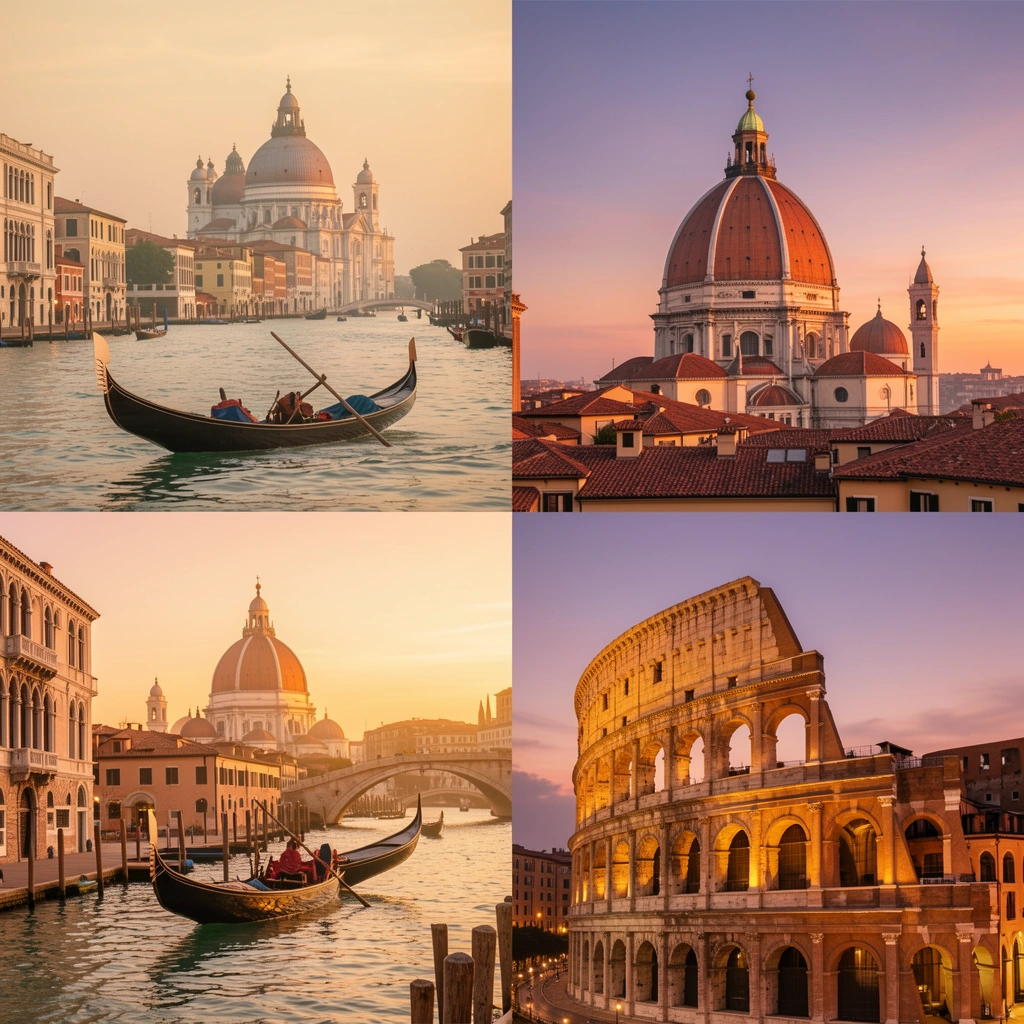
A multi-centre Italy holiday means two or more cities on one trip, linked by high-speed rail rather than a second flight. The classic pairing is Rome and Florence — four nights, two in each, from £339 per person including return flights and the train between them. Add Venice and you have the full six-night circuit from £399. The trains do the heavy lifting: Rome to Florence takes 1 hour 25 minutes, and Florence to Venice about two.

Want an Italy route priced for your dates?
Tell us which cities matter most and how long you have. We will build the split around your flight times rather than the other way round.
The short answer
| Question | Answer |
|---|---|
| Easiest two-city route | Rome and Florence, 2 nights each |
| Classic three-city route | Venice, Florence and Rome, 2+2+2 |
| Rome to Florence by train | 1h 25m, 32 services a day |
| Florence to Venice by train | About 2h, 11 services a day |
| Minimum sensible length | 4 nights for two cities, 6 for three |
| From (per person) | £339 for 4 nights, £399 for 6, with flights |
| Cheapest month | January on 11 of our 12 Italy packages |
| Visa (UK passport) | None for stays up to 90 days |
Why Italy suits a multi-centre trip better than most countries
Most multi-centre holidays are built around a long-haul flight and a short connecting hop — a city for a few nights, then a beach, with an airport in between. Italy does not work like that, and that is the point.
The cities that people actually want to see sit on one high-speed line. Milan, Bologna, Florence, Rome and Naples run down the spine of the country, with Venice branching east. You check out of a hotel in the centre of one city and you are in the centre of the next before lunch, with no transfer to an airport, no bag drop, no security queue and no two-hour check-in. That single fact changes what is realistic in a week.
It also changes the maths. A second city on a beach holiday usually means a second flight. In Italy it means a train ticket, which is why a two-city Italy trip costs so little more than a one-city one.
6 Nights Venice, Florence & Rome
5 Nights Rome & Venice
All multi-centre holidays
The routes worth doing, and who each one suits
Rome and Florence — the two-city starter
Four nights, two in each, and the shortest hop on the network between them. Rome gives you the Colosseum, the Roman Forum and the Vatican; Florence gives you the Uffizi, the Duomo and a centre small enough to cross on foot in twenty minutes. The contrast is the appeal — Rome is loud, layered and exhausting in a good way, Florence is compact and calm by comparison.
This is the route to pick if you have a long weekend and have never done Italy properly. From £339 per person for four nights, with return flights and the high-speed train between the two cities included.
Rome and Venice — the lowest-priced pairing
Five nights: three in Rome, then the high-speed train north — about three and a half hours — for two in Venice. You fly into Rome and home from Venice, so nothing is spent doubling back. It leaves Florence out, which makes it the simplest way to see the two cities most people come to Italy for.
From £259 per person, from November to February, with flights and the train included — the lowest lead-in price of any multi-centre holiday we sell.
Venice, Florence and Rome — the classic circuit
Six nights, two in each city, and the route most people picture when they think of Italy. Venice first, then Florence, then Rome works well because it runs north to south down the line, and because Rome has the most flight options for getting home.
It is a lot of moving for six nights, and it suits people who would rather see three cities properly than one city exhaustively. From £399 per person with flights and train connections.
Milan, Lake Como and Venice — city, lake and canals
The one that breaks the pattern. Two nights in Milan, two at Lake Como and two in Venice, so you get a working Italian city, a lake and a lagoon in one six-night trip. Como is the reason to choose this one — it is the only route here that gives you somewhere to slow down in the middle.
From £439 per person for six nights with flights and train travel between cities.
The longer circuits
Nine nights on the Italy Grand Explorer from £359 per person, or twelve on the Ultimate Italy Tour through Rome, Florence, Venice and Milan from £799. Both are built around scenic high-speed journeys rather than a fixed coach itinerary.
There is also a Milan and Swiss Alps escape from £459, which pairs Milan with the Bernina Express — worth knowing about if the railway itself is part of the draw rather than just the way between two hotels.
How the trains actually work
This is the part that decides whether a multi-centre Italy trip feels effortless or fraught, and it is simpler than most people expect.
Two operators run the high-speed routes — Trenitalia, whose fast trains are branded Frecciarossa, and Italo. They use the same tracks and the same central stations, and on the busiest routes they compete directly, which is why frequency is so high.
| Route | Journey time | Services a day | Stations |
|---|---|---|---|
| Rome → Florence | 1h 25m | 32 | Roma Termini or Tiburtina → Firenze S.M. Novella |
| Florence → Venice | About 2h | 11 | Firenze S.M. Novella → Venezia S. Lucia |
| Milan → Venice | 2h 15m | 7 | Milano Centrale → Venezia S. Lucia |
Journey times and daily service counts published by Italo, checked 22 September 2026. Trenitalia also operates these routes and its timings are broadly comparable.
Three things are worth knowing before you travel.
The stations are central. Firenze Santa Maria Novella is a ten-minute walk from the Duomo. Venezia Santa Lucia opens directly onto the Grand Canal — you step out of the station and the water is in front of you. Roma Termini sits on the metro. This is the real advantage over flying between cities: you arrive where you want to be, not forty minutes outside it.
Seats are reserved. High-speed tickets in Italy are tied to a specific train and a specific seat, so you are not boarding whatever turns up. The flip side is that missing your train is not trivial, and the cheapest fares are the least flexible.
The frequency is your safety net. On Rome to Florence there are 32 services a day, so a slow morning is an inconvenience rather than a disaster. Florence to Venice at 11 a day and Milan to Venice at 7 need a little more planning — on those legs it is worth not booking the last train of the day.
On our packages, the train legs are included. The Rome and Florence break includes the high-speed train between the two cities; the Venice, Florence and Rome holiday and the Ultimate Italy Tour include all connections between cities. You are not buying rail tickets separately or working out which operator to use.
How many nights in each city
Two nights per city is the working minimum, and it is what every one of our multi-city Italy packages is built on. Two nights gives you one full day plus two part-days, which is enough for the things a city is famous for and not much else.
That is an honest trade. Two nights in Florence covers the Uffizi, the Duomo and Ponte Vecchio at a decent pace. It does not cover a day trip to Siena. Two nights in Rome covers the Colosseum and the Vatican if you are organised about it, and you will still leave things undone — Rome always leaves things undone.
If you have longer, the better use of the extra nights is usually to add depth rather than another city. Three nights in Rome is a noticeably different holiday from two. Four cities in a week is a train timetable with a holiday attached.
A rough guide: four nights suits two cities, six suits three, and anything beyond three cities wants nine nights or more — which is what the nine-night and twelve-night circuits are for.
Venice is the city this maths is kindest to. It is small enough that two nights genuinely covers the historic centre, which is why our shortest Italian break is built that way and starts at £129 per person with flights. The Venice guide sets out what those two nights cost in each month of the year, and what changes when you add Florence and Rome to them.
What it costs, month by month
Every package carries a live month-by-month price, so these are the actual figures rather than an average or an estimate.
| Package | Nights | January | July | November |
|---|---|---|---|---|
| Rome & Florence Twin City | 4 | £339 | £429 | £349 |
| Rome & Venice | 5 | £259 | £499 | £259 |
| Venice, Florence & Rome | 6 | £399 | £549 | £459 |
| Milan, Lake Como & Venice | 6 | £439 | £549 | £459 |
| Italy Grand Explorer | 9 | £359 | £599 | £389 |
| Ultimate Italy Tour | 12 | £799 | £969 | £819 |
All prices are per person and include return flights from London. Regional departures can be priced on request, at a supplement.
Two patterns come straight out of those numbers, and both are useful.
July is the most expensive month on all thirteen of our Italy packages — outright on twelve, and level with August on Rome and Venice. Not August, which most people assume. If your dates are flexible at all, moving off July is the single biggest lever on the price.
January is the cheapest month on eleven of the thirteen, and joint cheapest on a twelfth. That is a real winter-city holiday rather than a compromise: Rome, Florence and Venice are all indoor-heavy destinations, the queues are shorter, and the light in Venice in January is worth the cold.
Is a multi-centre trip more expensive than one city?
Less than you would think, and the gap is smaller than the same comparison in almost any other destination.
Comparing our own Italy packages: the seven multi-city routes work out at a median of £67 per night, and the six single-city breaks at £63 per night. Roughly £4 a night is what the extra city, the extra hotel change and the train between them costs.
There is a second effect that surprises people. Multi-city packages swing far less between seasons than single-city breaks do. Across the year, the multi-city routes move by a median of 31% between their cheapest and dearest month. The single-city breaks move by 70%. The two-night Venice escape more than doubles between January and July; the twelve-night circuit rises by 21%.
If you are booking in a peak month, the multi-centre option is proportionally better value than it looks in January.
Practical things worth knowing
Entry. British passport holders need no visa for Italy for stays of up to 90 days in any 180-day period. Your passport must have been issued less than ten years before the date you arrive, and have an expiry date at least three months after the day you leave the Schengen area. The ten-year rule catches people out — passports renewed early before October 2018 can carry extra months that no longer count. Checked against GOV.UK travel advice on 22 September 2026.
The EU Entry/Exit System. Biometric registration — fingerprints and a photo — is replacing passport stamping as it rolls out. It is free, and it makes later trips faster, but allow extra time at the border on your first crossing.
Packing for a moving trip. You will be getting on and off trains and in and out of hotels every two days. Italian city-centre hotels are frequently in old buildings with small lifts or none. One bag you can carry up a flight of stairs is worth more here than it is on a beach holiday.
The order matters for the flight home. Rome has the most departures back to the UK, which is why the three-city circuits tend to end there rather than start there.
Frequently asked questions
Which Italian cities work best together for a multi-centre holiday?
Rome and Florence is the easiest pairing — the two cities are 1 hour 25 minutes apart with 32 trains a day. Adding Venice makes the classic three-city circuit. Milan pairs naturally with Lake Como and Venice if you want a lake in the middle rather than a third city.
How long is the train from Rome to Florence?
1 hour 25 minutes on the high-speed service, running from Roma Termini or Roma Tiburtina to Firenze Santa Maria Novella. Italo publishes 32 services a day on the route, and Trenitalia runs Frecciarossa services alongside it. Figures checked 22 September 2026.
How many nights do you need for a multi-centre Italy holiday?
Four nights for two cities and six for three, split two nights per city. Two nights gives you one full day plus two part-days in each place. Three or more cities with any time to spare wants nine nights or more.
Can you do Rome, Florence and Venice in a week?
Yes, and it is the most popular route in Italy. Six nights at two per city covers it, with train connections between each. It is a fast-moving holiday — you are changing hotels twice — but the journeys themselves are short.
What is the best order to visit Rome, Florence and Venice?
Venice, then Florence, then Rome. It runs north to south along the high-speed line so no leg doubles back, and it finishes in the city with the most flights home to the UK.
Is a multi-centre Italy holiday more expensive than a single city?
Only slightly. Across our Italy programme the multi-city routes work out at a median of £67 per night against £63 for single-city breaks. Because the cities are linked by train rather than a second flight, the extra leg costs far less than it would in most destinations.
What is the cheapest month for a multi-centre Italy holiday?
January, which is the lowest month on eleven of our thirteen Italy packages and joint lowest on a twelfth. July is the most expensive on all thirteen — more than August on twelve of them. Moving your dates off July is the biggest single saving available.
Are the trains between cities included?
On our multi-city Italy packages, yes. The Rome and Florence break includes the high-speed train between the two cities, and the Venice, Florence and Rome holiday and the Ultimate Italy Tour include all connections between cities.
Do I need a visa for Italy?
Not for a UK passport holder travelling as a tourist for up to 90 days in any 180-day period. Your passport needs a date of issue less than ten years before you arrive and an expiry date at least three months after you leave the Schengen area. Checked against GOV.UK on 22 September 2026.
Can I fly from a regional airport rather than London?
Yes. The published prices are based on return flights from London, and regional departures are available at a supplement. We confirm the airport, the flight times and any supplement in writing before you pay anything.
Ready to put a route together?
Tell us your dates and which cities you want. We will price the split, book the train legs and send it through in writing before anything is confirmed.